
Kambi Moto residence Hurumaresidence Huruma

26th January 2023

Interview
Interviewer: Tell us a bit about your life?
My name is Peter Chege, and I live in this village. It used to be called Kambi Moto but sometimes back we it changed to New Mathare Highrise because of the construction the we did ourselves together with my fellow community members. Myself I am proud of this house.
This project we started it in year 2000, and in this project we had some challenges but most importantly we succeed. We started construction works in the year 2003, but in the year 2000 we were only doing savings. We used to call it daily saving, we held our meetings on Sundays where by three people were chosen who used to go and collect money from every member in this village. We have done a lot before us reaching this far because in the years 2001 and 2002 we had many activities which we used to do like; counting the number of people in the village, measuring the width of our village and also dreaming the kind of house that we would like to live in. Because we had to change our way of life. Then, we used to live in houses made of iron sheets.
Secondly, we had to do the follow up in order to know the real owner of the land. That’s where we started mostly so as to request the land owner the permission to build permanent houses with better security, houses that could have services like water, electricity, so that we could live the way we are now.
We found out that the land owner then was the City Council and currently it is called Nairobi County who are still the land own even to date. We made an agreement with them under the terms and conditions that were given to us as the dwellers of this village. The agreement stated that those who will get an opportunity to own a house must be living here in this village. And they would not recognize the owners of the house which were made of iron sheets as landlords. The city council then was the landlord and the owner of those houses were only the structure owners.
So when we came into agreement, we conducted counting of people and we knew how many we were. And also we came up with the idea of the kind of houses that we wanted to build. Everyone was given an opportunity of give an idea or dream of the kind of a house they wanted. And most of us had big dreams, like me personally I dreamt of a house with even a parking area which could not be allowed in a village be the space and the land was small.
The design and the plans of these houses originated from one of our members who was elderly. Who dreamt of house with a sitting area, kitchen, a bedroom and another bedroom for the visitors. And that was concluded to be a two bedroom. Because of the size of the land and the number of people who were there the community agreed upon the design. But that design was changed a little bit where one of the room was to be built on top to create more space for other families.

Interviewer: Tell us more about those who designed these houses and how you built the previous license model.
Throughout that process, we used to receive support from an organization called Pamoja Trust, and even today it is still there. They used to support the communities that were living in poor housing. They used to enlighten them on how they could own the places that they were living if the follow the right procedures. They started by telling people how they could do daily savings and encouraging them to be holding meeting where they could discuss matters pertaining those places that they lived. If we look at Kenya at large, lands do not change or enlarge but the population keeps on increasing. And since population keeps on increasing, that organization taught us that we should try and gain the ownership of the places that we used to live. The only difference is that after fighting to get its ownership, one can also start developing it. So when we united as a community they were able to support us in build these houses. The community came up with the plan and design of these houses because we had started first of all by building cloth model house which we had drawn on box model house. It was later changed to a permanent cloth model house that we had built as community. And women helped a lot in tying those clothes. That model was displayed for a month to the community so that everyone could see the design of the houses that would be built.
That organization also arranged seminars and invited people India who trained us new building technologies. We were trained on how to make some building material, such as laddish (waffle slabs) and T-beams which we used while constructing our houses. After learning those new skills we also started moving out to train others. We travelled to Kitale and even to other countries like Uganda and many other.
I can say that I have benefited much from this house because no landlord that comes here to asking money for house rent. The entire community in general has benefited much because we have the facilities in our house like water, electricity and we live comfortable life.
From the history, this village was named as Kambi Moto because there was fire outbreak almost three times per year. And that was a nickname from our neighbouring villages, later it became a permanent name for this area. After we finished constructing these house as a community we decided to change the name. Since this entire area is called New Mathare, we decided to call it New Mathare Highrise so at least we have made a progress.
We have worked in collaboration with Nairobi County, and we are still making the follow up for the tittle deeds. And we will recently get that title deeds although first we will get communal tittle deed and later individuals will get lease showing that they own a house in this land.
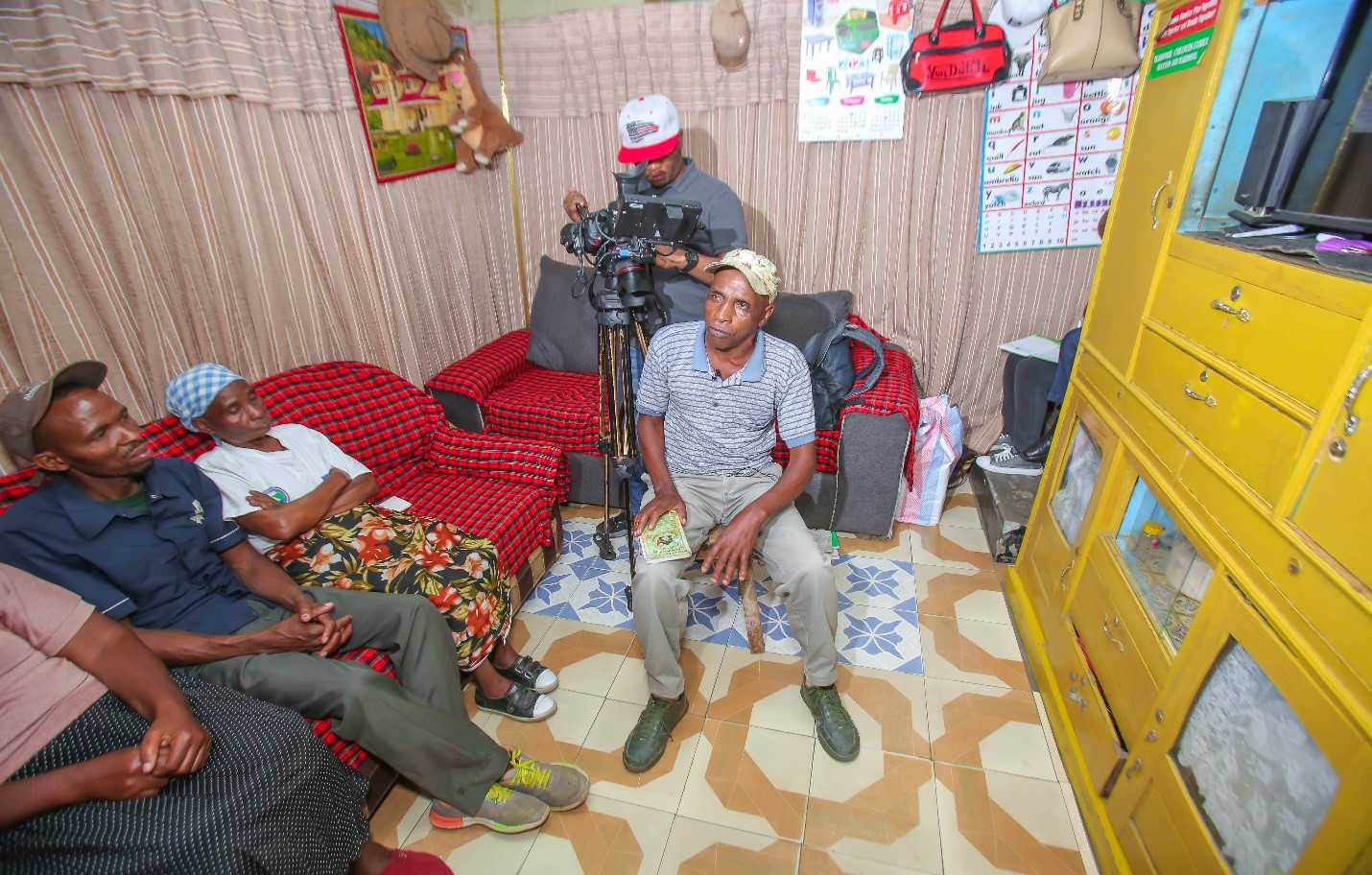
Interviewer: As you built this house as an incremental housing, did you occupied this house in between after finishing construction first floor? Explain for us how you did it.
That is a very good question to me because, we started constructing these houses on year 2003. And if I give a brief history on how we built them, these houses were built starting from site 1, site 2, site 3 and site 4. But on site 1 we built 34 units, and we built those unit for 2 years because that time we were training ourselves how to build as community. And we faced some challenges because may be the organization delay in realizing funds for the project or the community members failed to avail themselves for work. And we were also in the process of training ourselves so that took time.
In the year 2005, I was the first person to occupy my house in this estate in the first site. During the time of construction I was living in my aunt’s place. I occupied this house immediately after construction of the ground floor or starter +1 was finished. I left my left wife and move to my new house alone because I was so excited of this new house. Other people also started occupying theirs and as construction works continued. For we had agreed that one can occupy the house when it was finished at starter plus one, with toilet, bathroom and water.
In site 2, we built 28 units within 6 months because the people were already experienced. So people were very first in making those pre-casted materials. In site 3 we built 24 units which didn’t even take more than year to finish because people had skills. So it is the challenges that we had at the beginning that made us to delay a bit in site 1.
While we continued with construction in site 1, there as discussion going on between us and structure owner who took long before they started demolishing those iron sheet houses .Much time was wasted as we waited to get more spaces for building more units.
Interviewer: What was your role during construction process?
Then I was Chairman of the group, but before we started savings I was group secretary. We used to conduct the elections after every year and mostly those positions were inter-changed. The main role that I played in this Estate was chairmanship.
Interviewer: Have there been challenges?
Yes, I had a lot of them. And those challenges came from all over. They came from the member, surroundings, but mostly I got them from the members that I used to lead. Because some could see the progress you are making and others couldn’t see any so one had to fight all those challenges. And the main challenge I was facing was trying to convince the structure owner to demolish their houses. Because there are some who thought that their houses were forcefully taken and I was behind all that as a Chairman. After sometimes they agreed and now were fine.
Interviewer: Tell if there was any improvements in the infrastructure; drainage system, sewage how it used to be and if it is of any importance today?
That is an important issue because while we lived in those other house, we really wanted to have good infrastructure; good sewer lines and availability of water and also land ownership. As residents of this estate, we were very lucky because Pamoja Trust organization connected us to another organization called COPY. That organization, COPY assisted us in constructing sewage systems without loan nor any charges. Everything was done free of charge. They even constructed roads in the streets for free. And that made us very happy because there was no loan to be paid back. They were providing finances for us and people from the community used to volunteer in providing labour. As since professionally I am a mason I was given that contract as a contractor where I was able to do that work other people from the community. Even now that sewage system is working properly without any problem.
Interviewer: Tell us the benefits of this house to you and your family.
First I can say this is my house, and it has a lot of benefits to me because my children grew up here, schooled from here and my wife and I live in here. We have four children and some are already married with their own families. I don’t regret because of the hard works that I ever did or the challenges that I faced from the society because now I am in my house. And one of the greatest benefit is that most of the people who resides here at site 1 used to be tenants. As tenants, at the end of month landlords could come knocking at the door asking for house rent of Kshs 500 failure to which their houses could be locked. Then those houses used to be rented at Kshs. 500 per month, but for me I never rented one. I am very happy that those who used to rent houses they now own a house after struggles. We have freedom while living in these houses and only the small part is remaining of getting the tittle deed to showing our legal ownership. And I believe that we are getting that tittle deed soon.
Interviewer: Tell us how this project empowered you economically.
Most of the in this estate have their own small businesses while others work from outside the village and comes back. But there are also some members from this area who joined together and started car wash business. This car wash business has created job opportunities for many young people who completed their studies but had no job. And they are able to be dependent on themselves. People also help each other especially we builders if one gets job opportunity we always informs others.
Interviewer: there are those renting their houses or part of their houses to others, how much do they charge them?
A house like this one can be rented at Kshs. 5,000 or 4,000 depending on their agreement but people always mind about their fellow community members.
Interviewer: As you are helping others to build their own houses are you using this area as a training ground.
the time that we were constructing these houses many people came here to acquire skills, infact we thought people for Kibera will using the same design because they participated a lot during construction as we trained them how to make laddish and beams. And they really helped with labour and so we thought they too will apply those skills although that didn’t happen. As builders, when we get jobs outside we prefer making those materials from there so that we can train young people from those areas. For example in Juja, the was a residential house that we built there with this design and we trained youths from there, also a place called Ruai there are young people there using this method. Although we always tell them to inform us during laying of those materials because they require a particular design.
Interviewer: In the neighbouring villages is there any that have used the same construction skills that you have?
in the neighbourhood, there is village called Gitathuro, Mahira and Ghetto, all these villages are have constructed their houses using this method. Although we were trained together, the turn up from those villages were not as high as compare to our village. It is people from this slum who were mostly involved during constructions in the neighbouring slums and of implementation the new skills. If you go those neighbouring slums you can find same model houses and even in Kahawa Soweto.
Interviewer: Do you have anything you would like to add?
The people living in the slums should unite together and start savings with an intention of doing a particular thing. Because as I mentioned earlier we started by counting ourselves and got the number that could fit in this piece of land. But there was those people who were excluded because they bought a piece of land in another place and they have an intention of using the same design while constructing their own houses but some have already built using this method in area of Syokimau and Katani. We are the one who assisted them to construct their houses in those areas.
There are also some houses that I saw which are being constructed in the same method by the people from Muthurwa market in place called Tala. They have visited us for several days and we have shared the same ideas with them.
I would propose to the government to train people to be doing their own savings but to their own accounts instead of other peoples saving that money on their behalf. Because for us we knew we were saving with a purpose of building houses. And that was our main dream. So the government should try and assist the organized to communities to achieve their dreams as we did.
Interviewer: Are the open spaces in this area used for the intended purposes?
Yes, they are usually used by women whenever they need them or by children while playing. Nowadays we are also lucky our road has been constructed by Nairobi County and the children are also playing there although it’s a bit risky. Mostly on Sundays or during holidays you can see them playing in those open spaces.
Interviewer: Tell us how used to do savings and factors that led to unity among the community members?
Let me start by saying before we united, around year 1998, 1996 there used to be a lot of things happening. There was a lot of evictions and grabbing of the public lands. But Pamoja Trust and Kenyan government tried to look for solution on how to stop those demolition which took place then.
So when they enlightened us on the importance of uniting together we embraced that idea because we knew if we could unite together, no one could evict us from that area. And the only way of uniting us was starting saving money together. It was started by five women and I was the sixth person to join. I too like their idea of saving and they used to save 5 shillings, 10 shillings or 20 shillings. And the one who used to save a lot then was saving only 20 shillings. And if you look at my you can that how we used to save. There was one member of the group who used to save only 5 shillings. The one thing that helped us a lot was weekly meeting, which we did on Sundays. During those meeting our treasurer could bring the bank slips that had been used to bank money from Monday until Saturday. There was a lot of transparency. That saving helped to start building these houses. We were able to go to the city council asking for permission to owning that land and start to building houses.
During that time we had gone for the negotiation, we had a saving of Kshs.250, 000 in the bank. So we went there with an intention that if could not grant us the permission to own that land then we would ask those Directors there to sell that land to us. That money could act as our deposit because it couldn’t be enough for buying. But God intervened and they accepted to give out that land free of charge but on conditions. I had mentioned earlier so of the conditions that it only those living there in the slum would benefit.
The people who lived in the slums were from different ethnics groups from all over our nation. So all had to be beneficiary. The main thing that united us was that we used to live together in the same village and also used to do our savings in one group. And the condition were ownership was to be given to those who resided there. During the time our counting ourselves there was all sort of names from different tribes. Like now my neighbor is Luhya and I have another one who is a Kamba. And we live in peace without chaos. Our happiness is that we own this village and we got the services that we needed.
Minister Beth Tett had visited this slum, but there is a person that I can’t forget was called Mayor Joe Aketch who inaugurated these houses. He signed the memorandum of understanding (MOU) because he had already agreed a Mayor. The councilor then was called Grace also signed that document and we too also signed. So that Mayor assisted us a lot to make progress in that project. We are very happy about that.
Interviewer: During election process did you have any issues because of mixed cultures?
We are at the stage where by everyone is minding about their family issues and the greatest and most important thing is everyone is securing our village from all ethnic groups. Every person mind their own business so there is no issues per say. Even in the process of getting tittle deed we do it together.
Interviewer: Who is currently in- charge of the community?
Currently we are having KESIP which has SEC (Settlement Executive Committee) who are after ownership document or tittle deed. In that SEC, we have the Chairman, vice- Chairman who are living among the community.
© 2025 Taji Research Developed by Be Seen Limited
WhatsApp us
